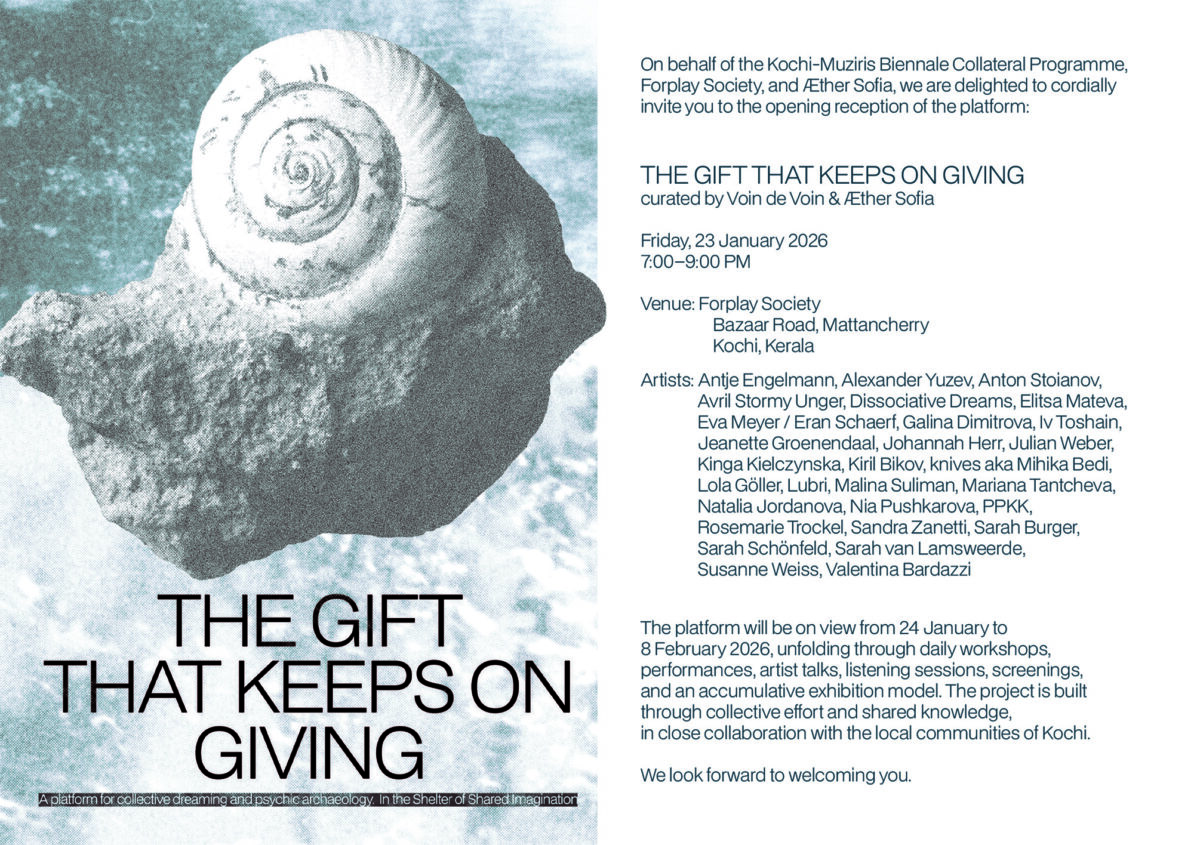
23.01.2026 - 08.02.2026
Curated by Æther / Voin de Voin for Forplay society at Kochi-Muziris Biennale, Collateral program
The platform is carried out by
Antje Engelmann (DE), Sarah Burger (CH), Susanne Weisse (DE), Anton Stoianov (DE/BG), Julian Weber (DE), Iv Toshain (AU), Johannah Herr (USA), Eva Meyer/Eran Schaerf (DE), Rosemarie Trockel(DE), Nia Pushkarova (BG), PPKK (DE, GR), Galina Dimitrova (BG), Jeanette Groenendaal (NL), Mariana Tantcheva (NL/BG), Sandra Zanetti (USA/UK), knives aka Mihika Bedi (DE/IN), Lola Göller (DE), Kiril Bikov (BG/DE), Kinga Kielczynska (PL), Alexander Yuzev (BG), Natalia Jordanova (Nl/BG), Sarah van Lamsweerde (NL), Lubri (BG), Malina Suliman Nl/AF), Elitsa Mateva (BG), Valentina Bardazzi (IT), Avril Stormy Unger (IN), Dissosiative Dreams (CAN)
Voin de Voin is an artist whose practice unfolds through a symbiotic relationship with his cosmic other Æther, together forming a single, interdependent matter. This dual presence operates as both method and material, form and dimaterialisation, dissolving boundaries between author and process.
Their work centers on collective rituals and shared modes of working, emphasizing collaboration as a form of knowledge production. Through participatory structures and communal acts, they explore how meaning is generated, transmitted, and transformed when creation becomes a collective endeavor rather than an individual gesture and the potenciality of that energy.
By fostering processes of cooperation, exchange, and learning, Voin de Voin and Æther investigate art as a living system—one that emerges through shared ideas, psychic archeology, ritualized interaction, and the continual circulation of knowledge.
THE GIFT THAT KEEPS ON GIVING
A platform for collective dreaming and psychic archaeology.
In the Shelter of Shared Imagination.
There are transmissions that exceed intention. Long after the event has passed, their presence remains.
They do not ask to be remembered.
They remember for us.
TheGift_Book_Online_finalDownload
Some gifts do not come wrapped in meaning. They pass silently through proximity, through repetition, through the atmospheric residue of the unsaid. They do not require consent. They embed. They linger. They return. Not because they were invited, but because they cannot be dismissed.
This exhibition takes that condition, not as metaphor, but as architecture. It explores the radical potential of dreaming together not merely as an escape, but as a generative and political act. Across cultures and histories, dreams have served as maps, messages, and mirrors offering insight, healing, and sometimes prophecy. When these dreams are shared, whether in conversation, ritual, or image, they begin to shape a language beyond logic, one that resists the rational enclosures of the waking world.
The artists and practitioners in this journey navigate this terrain through diverse forms and practices, building a constellation of work over three weeks. Their investigations illuminate the tension between the intimate and the collective, between individual psyche and social fabric. What emerges is not a single dream, but a living network fleeting and fluid of many.
At the heart of this exhibition is a question: What happens when we give ourselves permission to dream together?
Can we envision new architectures of care, kinship, and resistance? Can collective dreaming serve as rehearsal for more liberated futures?
We enter the exhibition as individuals; we leave as part of a larger dreaming body stitched together by invisible threads, by memory, by longing, by the quiet insistence of what still wants to be felt.
The commons of sleep expands, encompassing all who dare to close their eyes not to escape, but to imagine otherwise.
The gift persists. It moves through us. It dreams us forward.
The recent past has delivered to the global collective a rupture—an epistemic shock that dismantled the narratives of progress, stability, and evolutionary advancement that many had assumed were inevitable. Instead of the promised arc toward improvement, we entered a zone of extremity: wars unfolding with genocidal clarity, systemic cruelty fully visible, and a pervasive sense that the apocalyptic visions once confined to scripture may no longer be metaphor, but documentation.
This rupture did not arise as a singular event, but as a series of layered unveilings. Each crisis revealed another structure beneath it, forming an endless regress of nested mechanisms—like a stack of babushka dolls, each holding and protecting its own interior logic of domination. These systems, while appearing to offer safety, function as illusion-machines, producing a choreography of control that keeps subjects compliant, fragmented, and afraid.
In this climate, the human condition itself did not simply deteriorate—it underwent a profound disassembly. The frameworks through which we understand ourselves were crushed. We experienced a symbolic death: of trust, of continuity, of the belief that history necessarily bends toward justice. Emerging from this collapse, we were forced into a new condition: not chosen, not prepared for, but imposed—a condition defined by the triumph of the capitalist myth.
This myth operates not as a story but as an ontological force. It reconfigures reality by rewarding poverty with moralization, normalizing human and nonhuman sacrifice as economic “necessity,” and elevating the lie over the truth through systems engineered for virality, not veracity. Technology amplifies these distortions through algorithmic architectures of manipulation, producing subjects who are divided, surveilled, and rendered perpetually adversarial. The dream of a unified social body fractures into competing micro-realities, each calibrated for maximum extraction.
Historically, new mythologies emerge from the depths—from degradation, despair, and the psychic pits of collective trauma. They arise not as luxuries, but as survival mechanisms, constructed when humanity reaches for something to believe in, something to hold, something to orient toward when the dominant narrative collapses.
The project presented here positions itself within this threshold:
as an attempt to fracture the capitalist myth at the level of symbolic production,
and to re-engage with older, subversive, and suppressed modes of knowing.
Drawing from pagan ritual practices, witchcraft, ancestral memory, healing traditions, lucid dreaming, psychic archaeology, and emergent biotechnological methodologies, the platform proposes a re-imagining of the human condition—one that is not linear, rationalized, or optimized, but plural, porous, and interdependent.
We propose that the human mind cannot be understood as a singular, coherent unity. Instead, it resembles an internal ecology—a polyphony of processes, subsystems, ancestral residues, and emergent signals operating simultaneously. It is a society within the skull: a site of negotiation, conflict, cooperation, and myth-making.
In this model, universal truths are not fixed axioms but experiential structures that can be re-encountered, reactivated, and re-sensed.
By naming our collective fears, we perform an act of theoretical archaeology.
By speaking them aloud, we create a space where these fears become analyzable rather than paralyzing.
By listening—attentively, vulnerably—to the deepest strata of our new perceptual condition, we open pathways for alternative epistemologies to surface.
The work invites participants into the “forbidden zone”—a conceptual and affective territory where forms of sharing, vulnerability, and communal reflection are not only discouraged but systematically erased. In entering this zone, we engage in a counter-movement: a collective excavation. We dig through the coal-mines of the mind, unearthing new mythologies from the strata of a broken world, and searching for emergent forms of meaning, solidarity, and psychic reconstruction.
This platform is not a return, nor a retreat, nor a utopian projection.
It is an experiment in re-constituting the human condition after collapse—
a space to practice new senses, new rituals, new languages, and new forms of relation.
A site where myth becomes methodology,
and where the fragments of our shattered present might be rearranged into a future that does not simply replicate the violence of the past.
And in the deepest chamber of this descent, something begins to glow—
what the old ones might have called the gift that keeps on giving…
Supported by ifa – Institut für Auslandsbeziehungen e.V. (Institute for Foreign Cultural Relations), technical support by C.Rockefeller Center & Netzwerk Medien Kunst